
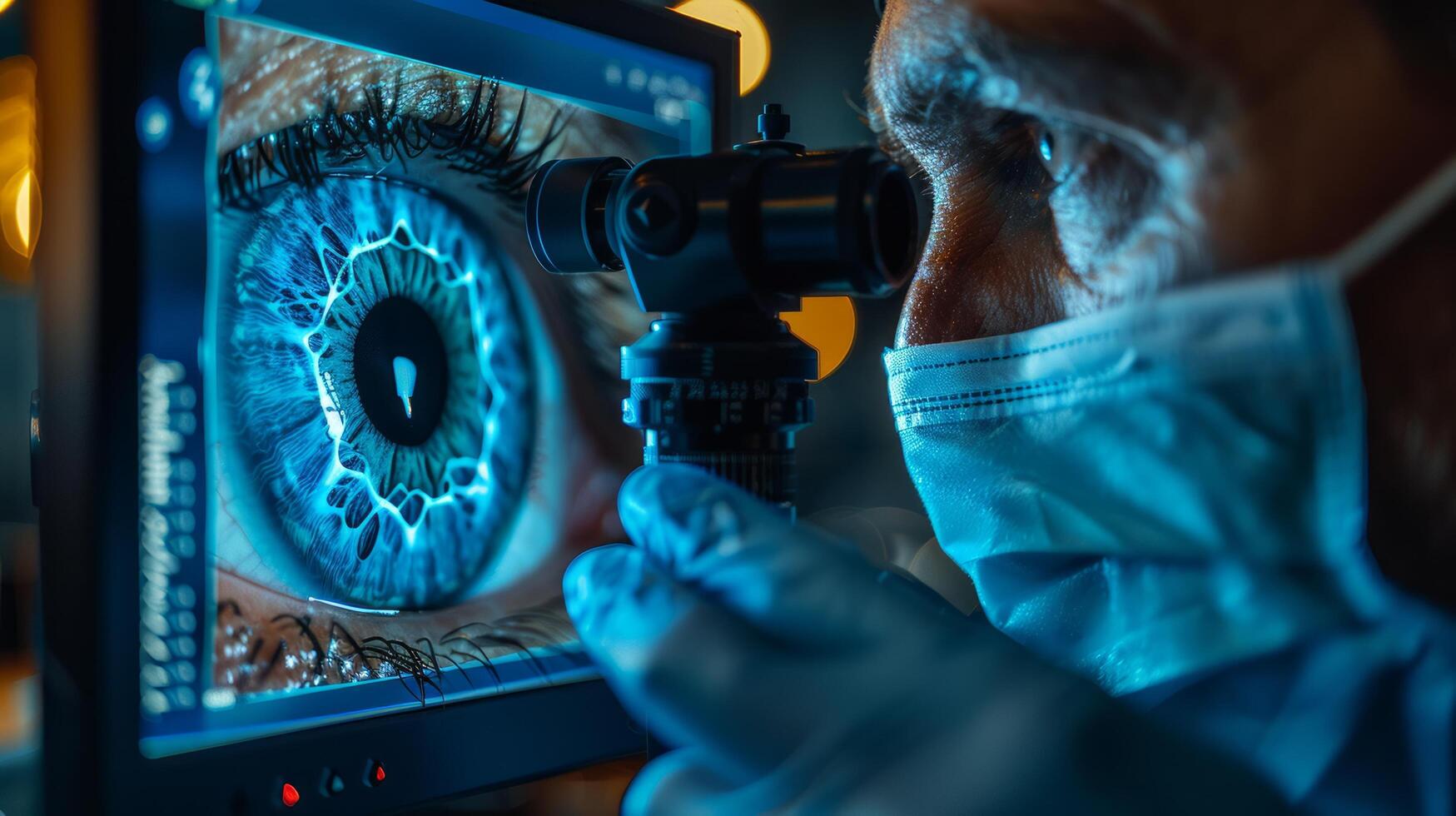
Many people in the United States see the world as blurry. Some wear glasses or contacts, while others have had LASIK surgery to sharpen their sight. Now researchers are exploring a completely different way to change the shape of the eye without lasers or cuts.
A team from Occidental College and the University of California, Irvine is testing a technique called electromechanical reshaping, or EMR. Instead of cutting away tissue, EMR briefly softens the cornea so it can be gently molded into a new shape.
Early experiments on rabbit eyes show that this method might one day be a cheaper, less invasive alternative to traditional laser eye surgery.
How LASIK Works
The cornea is the clear front part of the eye. It bends light so the image lands correctly on the retina. If the cornea is too steep, too flat, or uneven, vision becomes blurry.
LASIK uses a laser to shave off tiny amounts of corneal tissue and permanently reshape it. The procedure is common and safe for most people, but it can cause dry eyes, glare, halos, or a weaker cornea.
“LASIK is just a fancy way of cutting tissue with a laser,” says chemistry professor Michael Hill.
An Accidental Discovery
The idea for EMR came by chance while the scientists were studying cartilage and other collagen‑rich tissues. Professor Brian Wong explains that applying a gentle electric current changes the acidity (pH) of the tissue for a short time.
When the pH shifts, the bonds that keep the tissue stiff loosen, making it temporarily flexible. After the current stops, the pH returns to normal and the tissue hardens again, keeping the new shape.
Using Electricity to Shape the Eye
To test EMR, the researchers made tiny platinum “contact lenses” that match the desired curve of the cornea. Rabbit eyes were placed in a salty solution that mimics tears, and the platinum lens acted as an electrode.
With a small electric voltage, the cornea softened and slowly took the shape of the lens. The whole process lasted about a minute—about the same time as a LASIK procedure—but without cutting or lasers.
In tests on 12 rabbit eyes, 10 were treated to mimic correction of nearsightedness. Those eyes achieved the intended focus, and the cells stayed alive because the researchers carefully controlled the pH.
In separate experiments, the same technique helped clear up a cloudy cornea, a condition that today often requires a full corneal transplant.
Why EMR Excites Scientists
Because EMR does not remove any tissue, it could keep the eye stronger than LASIK does. Imaging studies showed that the cornea’s collagen structure stayed mostly intact, and the treated eyes stayed clear.
Researchers are now improving the electrode lenses so they can monitor the eye’s shape, moisture, and clarity during the procedure. They are also exploring whether EMR could fix farsightedness, astigmatism, or help repair other cartilage‑rich parts of the body.
The method might be far cheaper than laser surgery because it does not need large, expensive laser machines.
Still a Long Way to Go
EMR is still experimental. So far it has only been tested on isolated rabbit eyes, not on living animals or people. The next steps include longer‑term animal studies to see how stable the new shape is and whether any side effects appear.
“There’s a long road between what we’ve done and the clinic,” Hill says. “If we get there, the technique could be widely usable, much cheaper, and possibly reversible.”
For now, LASIK remains the standard way to surgically correct vision, but EMR opens the possibility of fixing blurry sight without lasers, cuts, or permanent tissue loss.
The research was funded by the National Eye Institute of the National Institutes of Health and the John Stauffer Charitable Trust.